Crystal Shops Near Me: How to Find a Good Local Crystal Shop
If you are searching for crystal shops near me, the short answer is to look for an independent gemstone or gift shop with knowledgeable staff, clearly labelled stones, fair prices and a range that includes both raw and polished pieces. A good local crystal shop is a place where you can see and hold the stones before you buy, ask questions about where they came from, and get honest advice about what you are looking at. This guide explains where to find crystal shops, how to judge their quality, how to spot fakes, what things should cost, and what a beginner should buy first.

What Is a Crystal Shop and What Does It Sell?
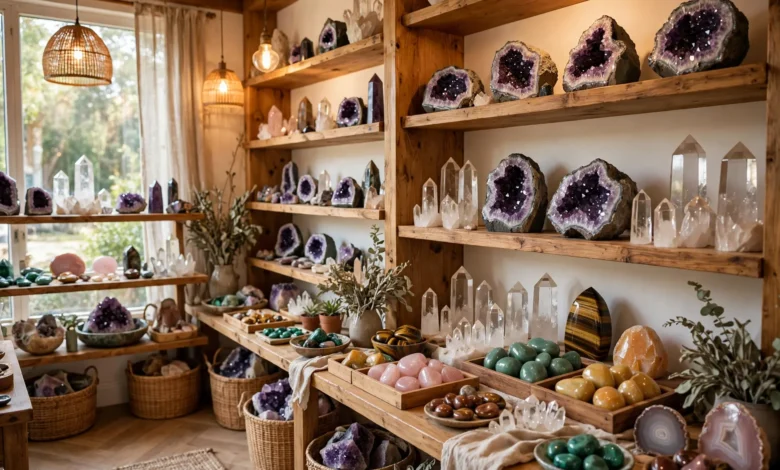
A crystal shop is a retail shop that sells crystals, gemstones and minerals, usually alongside related items such as jewellery, home decor and books. The core stock is made up of mineral specimens, which range from small tumbled stones that fit in the palm of your hand to large display pieces such as amethyst geodes, quartz clusters and polished spheres. Most shops also sell jewellery made with natural stones, including necklaces, bracelets and rings, as well as carved items such as hearts, towers, pyramids and animals. Some shops focus on the geological side of the trade, selling specimens with proper mineral names and origins, while others focus on the decorative or gift market.
The range in a typical crystal shop reflects the fact that crystals appeal to different people for different reasons. Some customers are collectors who want a particular mineral from a particular place, and they care about the specimen’s quality, size and origin. Others are looking for a gift, a piece of jewellery or a decorative object for the home, and they care more about how the stone looks. A third group is interested in the beliefs and traditions associated with crystals, and they may ask about the meanings that different stones are said to carry. A good shop serves all three groups without pushing any one of them, and its staff should be able to talk about the geology of a stone as easily as they talk about its appearance.
Where Can I Find Crystal Shops Near Me?
Crystal shops near me are most often found in town centres, shopping arcades, markets and alternative or gift-shop districts, and the most reliable way to find one is to search maps and review sites for crystal shops, gemstone shops or mineral shops in your area. Look for shops with recent reviews that mention the range, the prices and the helpfulness of the staff, and pay attention to photographs of the shop interior, because a good crystal shop usually has an interesting and well-organised display. Many crystal shops are small independent businesses, so they may not advertise widely, and some are only open on certain days, so check the opening hours before you travel.
Markets and fairs are another good place to look, because mineral dealers often trade at gem and mineral shows, craft fairs and farmers’ markets, and these events can be a good way to meet sellers who do not have a permanent shop. New Age shops, gift shops and some jewellers also sell crystals, although their range may be smaller and their prices higher than a specialist shop. Online directories and local business listings can help you find shops you might otherwise miss, and local community groups on social media often know the best places. If there is no specialist shop near you, some larger gift shops and museum shops stock a small range of crystals, and these can be a useful starting point.
How Do You Tell a Good Crystal Shop From a Bad One?
A good crystal shop gives itself away in several ways as soon as you walk in. The stones should be clearly labelled with their correct mineral names, and the labels should include the origin of the stone where possible, because a shop that knows where its stock comes from is a shop that buys carefully. The display should be organised and clean, with different types of stone grouped together, and the staff should be willing to answer questions about the stones without pressuring you to buy. A good shop will also be honest about what it does not know, and it will not claim that a stone is something it is not.
A bad crystal shop, by contrast, often has vague or incorrect labels, with stones described by made-up trade names or by the properties they are supposed to have rather than by their mineral identity. The staff may push expensive pieces on beginners, or claim that a stone has special powers that cannot be verified. Prices that are far above or far below what you would expect are also a warning sign, because a shop that charges a large amount for a common stone is overcharging, while a shop that sells everything very cheaply may be selling glass or dyed stone. Trust your instincts: a shop that feels welcoming, organised and honest is usually a good place to buy, while a shop that feels pushy or secretive is usually not.
How Can You Tell Real Crystals From Fake Ones?
Telling a real crystal from a fake one is a skill that improves with experience, but there are several checks that a beginner can use. The first is temperature, because real quartz and most other crystals feel cold to the touch and stay cool for a few seconds, while glass warms up quickly in your hand. The second is imperfection, because natural crystals almost always have small flaws, inclusions or uneven colouring, while glass and resin copies are often perfectly clear and uniform. A third check is weight, because real stone is usually heavier than glass or plastic of the same size, and a stone that feels surprisingly light is worth questioning.
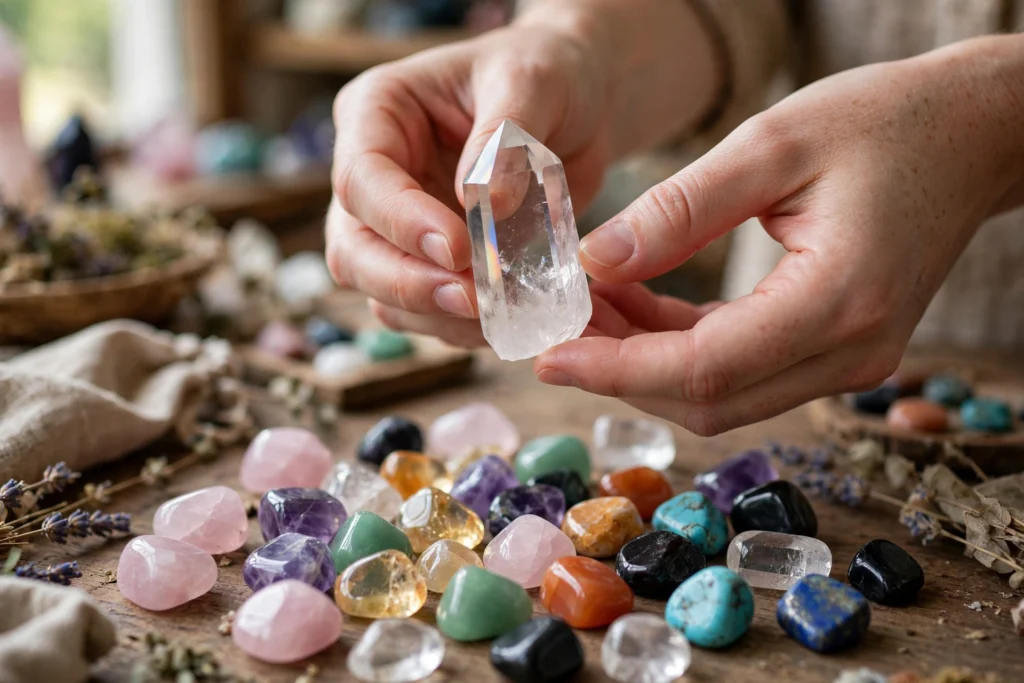
Colour is another useful clue, because some colours are rarely found in nature and are a sign that a stone has been dyed. Very bright blue, pink or green quartz, for example, is almost always dyed, and a deep purple stone sold cheaply as amethyst may be glass. Bubbles are another giveaway, because small round bubbles inside a stone are a sign of glass, while natural crystals have irregular inclusions rather than perfect spheres. Price is also a guide, because a large, flawless piece of a rare mineral sold very cheaply is unlikely to be genuine. If you are unsure, ask the shop for information about the stone’s origin, and consider buying a small, inexpensive piece first so you can learn what the real thing looks and feels like.
How Much Do Crystals Cost in a Local Shop?
The price of crystals in a local shop depends on the type of stone, its size, its quality and its rarity, but as a guide, small tumbled stones in the UK typically cost a few pounds each, while larger polished pieces and display specimens cost considerably more. Common stones such as clear quartz, amethyst and rose quartz are widely available and relatively affordable, because they are mined in large quantities around the world. Rarer stones, or specimens that are unusually large, well-formed or vividly coloured, can cost much more, and prices rise sharply for pieces that are collected rather than decorative. A small tumbled stone is a good starting point for a beginner, because it lets you learn about a stone without spending much money.
What matters more than the exact price is whether the shop is honest about what it is selling, and the best way to judge value is to compare prices across a few shops and online. A shop that charges a large amount for a common stone is overcharging, while a shop that sells everything very cheaply may be selling fakes. Some shops offer a discount for buying several stones at once, and market stalls are often cheaper than high-street shops because they have lower overheads. If you are buying a piece of jewellery, remember that the price includes the metal and the workmanship as well as the stone, so a silver setting will cost more than a simple cord. Always ask for a receipt, and keep it, because a reputable shop will stand behind what it sells.
What Should a Beginner Buy First?
A beginner buying crystals for the first time should start small, with a few common and affordable stones that are easy to find and easy to learn about. Clear quartz is a good first choice, because it is the most common crystal in the world and it comes in many forms, from small tumbled stones to large clusters. Amethyst is another good choice, because it is widely available, reasonably priced and easy to recognise by its purple colour. Rose quartz is also popular, and its soft pink colour makes it an attractive decorative stone. These three stones are a good foundation for a collection, and they are all available in most crystal shops.
The best way to choose your first stones is to handle them in the shop and see which ones appeal to you, because the look and feel of a stone are part of the experience. Start with tumbled stones, which are smooth, affordable and easy to carry, and add a small cluster or a polished point later if you want a display piece. Buy a book or a guide to minerals as well, because learning the proper names and origins of your stones will make your collection more interesting. Do not spend a large amount on your first visit, and do not buy a stone because someone tells you that you need it. A good first collection is a small one, built slowly, with stones that you chose yourself because you liked them.
What Else Do Crystal Shops Sell?
Crystal shops sell much more than loose stones, and the range can be surprising if you have never visited one. Jewellery is a major part of most shops, including necklaces, bracelets, earrings and rings set with natural stones, and the quality ranges from simple beaded bracelets to silver and gold pieces. Home decor is another large category, with items such as carved animals, spheres, towers, pyramids, bookends and lamps made from stone, and these are popular as gifts and decorative objects. Many shops also sell incense, candles, books about minerals and geology, and tools such as display stands and cleaning cloths.
Some crystal shops also sell items connected with the traditions and beliefs associated with crystals, such as tarot cards, oracle decks, pendulums and smudging herbs, although the range varies a great deal from shop to shop. A shop that focuses on geology will have a different range from a shop that focuses on gifts or on spiritual items, and neither is better than the other. The important thing is that the shop is honest about what it sells and does not present decorative or gift items as rare mineral specimens. If you are looking for something specific, call the shop first or check its website, because the range in a small shop can change quickly as stock sells.
Are Crystal Healing Claims Real?
Many people who buy crystals believe that different stones have properties that can affect health, mood or energy, and this belief is part of why crystal shops are popular. It is important to be clear about what is known and what is not: there is no scientific evidence that crystals can heal illness, treat medical conditions or change a person’s health, and no reputable medical organisation recommends crystals as a treatment for any condition. The Gemological Institute of America, which is one of the world’s leading authorities on gemstones, describes crystals in terms of their geology, chemistry and physical properties, not in terms of healing powers.
That does not mean that people do not value their crystals, because many people find that holding or looking at a beautiful stone helps them feel calmer, more focused or more positive, and that experience is real even if the mechanism is not medical. A stone can be a reminder to slow down, a focus for meditation or simply a beautiful object that makes a room feel nicer. If you buy crystals, enjoy them for what they are, and do not use them as a substitute for medical advice or treatment. If you have a health concern, speak to a doctor or another qualified healthcare professional, and treat any healing claim made by a shop or a seller with caution.
Conclusion
Finding good crystal shops near me comes down to looking for a shop with knowledgeable staff, clearly labelled stones, fair prices and a range that includes both raw and polished pieces. The best shops are welcoming and honest, and they will help you learn about the stones rather than pressuring you to buy. Whether you are starting a collection, looking for a gift or searching for a particular stone, take your time, handle the stones, ask questions and start small. A good first collection is built slowly, with stones you chose yourself because you liked them, and a good local shop is the best place to begin.
How Do I Clean My Crystals?
The safest way to clean most crystals is with lukewarm water and a soft cloth or a soft brush, followed by drying with a clean towel. Avoid harsh chemicals, ultrasonic cleaners and steam cleaners unless you know that the particular stone can handle them, because some stones are soft, porous or sensitive to heat and chemicals. Selenite, for example, should not be soaked in water, and stones such as malachite and turquoise should be cleaned gently and kept dry. If you are unsure about a particular stone, ask the shop where you bought it, because they should be able to tell you how to care for it.
What Is the Most Popular Crystal to Buy?
Amethyst is one of the most popular crystals to buy, because it is widely available, reasonably priced and easy to recognise by its purple colour. Clear quartz is also very popular, because it is the most common crystal in the world and it comes in many forms, from small tumbled stones to large clusters. Rose quartz is another favourite, and its soft pink colour makes it a popular choice for jewellery and for gifts. These three stones are a good starting point for a beginner, and they are all available in most crystal shops at affordable prices.
Are Crystals From a Shop Real or Fake?
Crystals from a reputable shop are usually real, but fakes do exist, and some shops sell glass, dyed stone or resin copies either knowingly or unknowingly. The best protection is to buy from a shop that labels its stones correctly, knows where its stock comes from and is willing to answer questions. Real crystals usually feel cold to the touch, have small natural imperfections and are heavier than glass or plastic of the same size. If a stone is very brightly coloured, perfectly clear or surprisingly cheap for its size, be cautious. When in doubt, start with a small, inexpensive piece from a well-reviewed shop.
Do Crystal Shops Sell Real Gemstones?
Yes, many crystal shops sell real gemstones, including both common stones such as quartz and amethyst and rarer stones such as tourmaline, garnet and aquamarine. The quality and price vary a great deal, and a shop may sell both mineral specimens and gemstones set in jewellery. A reputable shop will label its stones correctly and will be honest about whether a stone is natural, treated or synthetic. If you are buying an expensive gemstone, ask for a certificate or a written description of the stone, and consider buying from a shop that is a member of a trade association or that works with a gemmological laboratory.
Can Children Collect Crystals?
Yes, children can collect crystals, and many young collectors start with small tumbled stones, which are affordable, durable and easy to handle. A small collection of common stones such as quartz, amethyst, rose quartz and jasper is a good way for a child to learn about geology and the natural world. Supervise young children with small stones, because they can be a choking hazard, and avoid stones that are sharp, fragile or toxic. Some minerals, such as malachite, contain copper and should not be handled roughly or put in the mouth. A visit to a crystal shop or a gem and mineral show can be a great family outing, and many shops are happy to help a young collector choose their first stones.